
Most "weight loss food" lists are written from a hunch. This one comes from a very large study that followed what people ate, and what they weighed, for up to 24 years. The researchers did not ask whether fruit and vegetables help in general. They asked which ones, and the answer turned out to vary a lot from one food to the next.
The study behind this list
The paper was published in PLOS Medicine in 2015 by a Harvard team led by Monica Bertoia (PubMed 26394033). It pooled three long-running American cohorts with 133,468 men and women, tracked from 1986 to 2010. Participants filled in a diet questionnaire every four years and reported their own weight, so the team could see how a change in one food lined up with a change in weight over the same four years. They adjusted for smoking, physical activity, sleep, time spent sitting or watching TV, and other parts of the diet.
So each number below means this: people who added one daily serving of that food gained this much less weight over four years than people who did not. It is a link seen in data, not a trial result, and the authors say themselves that residual confounding cannot be ruled out.
1. Apples and pears
An extra daily serving of apples or pears went with 1.24 lb less weight gain over four years. That was larger than the figure for fruit as a whole, which was 0.53 lb per daily serving. The paper puts an apple serving at 74 calories, and its own example compares that with a serving of orange juice at 84 calories. The analysis covered whole fruit only. The authors left juice out because it often carries added sugar and has been tied to greater weight gain.
2. Berries
Blueberries and strawberries were grouped as berries, and an extra daily serving went with 1.11 lb less gain. Both fruits also showed up on their own in the list of individual fruits linked with less gain. One of the authors disclosed funding from the USDA and the US Blueberry Highbush Council for separate blueberry studies, which is worth knowing when you read this item.
3. Tofu and soy
This was the largest figure in the paper's summary. One more daily serving of tofu or soy foods, such as soy burgers, soybeans or miso, went with 2.47 lb less weight gain over four years.
4. Cauliflower and other cruciferous vegetables
Cauliflower on its own came in at 1.37 lb per extra daily serving. The cruciferous group as a whole, which the paper defines as broccoli, cauliflower, cabbage and Brussels sprouts, came in at 0.68 lb. The team also sorted vegetables by fibre and by glycemic load, which the paper calculates from the carbohydrate in a serving and its glycemic index. Vegetables that were higher in fibre and lower in glycemic load, with broccoli and Brussels sprouts given as examples, had a stronger link with less weight gain than carrots and cabbage.
5. Green leafy vegetables
Kale, spinach, mustard or chard greens, and head or romaine lettuce made up the leafy group. An extra daily serving went with 0.52 lb less gain over four years. That is a modest number. The authors still named leafy greens, together with berries, apples and pears, tofu, cauliflower and the cruciferous group, as the foods with the strongest results.
The vegetables that went the other way
Not every vegetable helped. More corn, peas and potatoes went with more weight gain, not less. The NHS treats potatoes as a starchy food, and says they do not count towards your 5 A Day. So "eat more vegetables" is only half the advice. Which vegetables you add, and what they replace, also matters.
Who was studied
The participants were mainly white, well-educated American adults, and the authors say the results may not apply to all adults. Diet came from questionnaires and weight was self-reported, so both carry some error. Read the five foods above as the ones most strongly linked with less weight gain in these cohorts. None of them is proven to melt fat.
Where dates come in
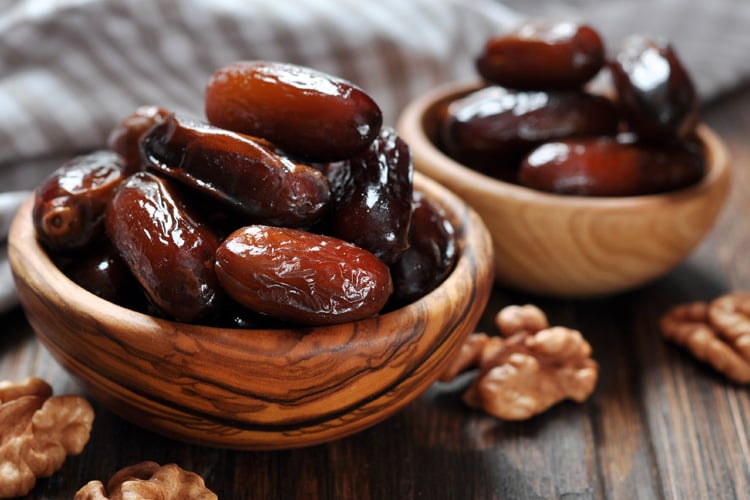
Dates were not on the study's fruit questionnaire, so the paper says nothing about them either way. Its fruit list did include two other dried fruits, prunes and raisins, which it paired with grapes. Both were among the individual fruits linked with less weight gain.
Dates are dense in energy. USDA FoodData Central lists Medjool dates at 277 kcal per 100g with 6.7g of fibre, and Deglet Noor dates at 282 kcal with 8.0g of fibre. The NHS says a 30g portion of dried fruit, such as dates, counts as 1 of your 5 A Day, but should be eaten at mealtimes, not as a snack between meals, to reduce the impact on teeth. A 30g portion of Medjool dates works out at about 83 kcal. Weigh it once so you know what a portion looks like.
Buying dates from Kurma Mariami
Kurma Mariami Malaysia supplies dates to consumers, retailers and traders and delivers across the country, as its about us page explains. For questions or orders, use the details on the contact page. More articles are on the Kurma Mariami blog.
An earlier version of this post linked to https://KurmaHarga.com, and that link stays here.
This article is general information, not personal advice. If you plan a big change to the way you eat, speak to your GP or a dietitian first.