
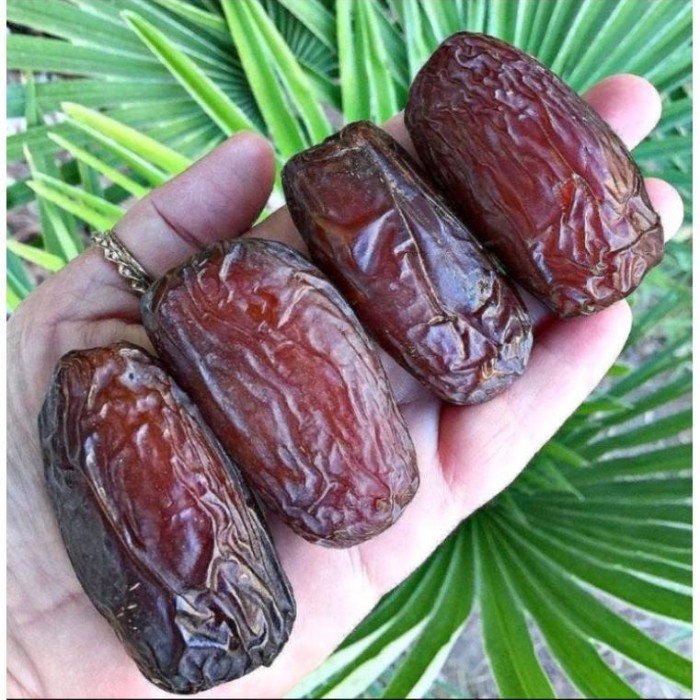
If you already buy soft-variety dates regularly, you have probably noticed that a box of kurma medjool can carry a wide range of prices even within the same shop. Part of that spread comes down to a grading system most buyers never see explained. Knowing how it works makes it much easier to tell a fair price from an inflated one.
How Medjool grading actually works
Commercial Medjool dates are typically sorted into tiers such as Jumbo, Extra Fancy, Fancy, and Choice. The names differ slightly between packers, but the underlying logic is consistent: size (measured by count per kilogram), uniformity of shape and colour, skin integrity, and moisture level. A carton of Jumbo-grade dates, larger and more uniform, will always cost more per kilogram than a Choice-grade carton of the same origin and harvest.
This matters because two suppliers can both advertise "Medjool dates" at very different prices while both being entirely honest — they are simply selling different grades. Asking a supplier which grade they stock, and comparing that against the price, tells you far more than the price alone.
Reading a count-per-kilogram spec
Most wholesale price lists quote a count range, such as "45-50 pieces/kg" for a large grade versus "60-70 pieces/kg" for a smaller one. Fewer, larger dates per kilogram generally means a higher price, since fewer individual fruits reach that size class during the harvest. If a listing skips this figure entirely, it is worth asking for it directly before comparing prices across sellers.
Why origin still matters within a grade
Even at the same grade, origin affects price. Palestinian and Jordanian Medjool carry the deepest-rooted cultivation history and are often positioned as the reference point for quality, while Californian and Moroccan-grown Medjool have expanded supply in recent years and can be more competitively priced at an equivalent grade. Neither is automatically "better" — they simply reflect different production costs, freight distances, and import duty structures reaching the Malaysian market.
A quick way to compare before you buy
When comparing two Medjool offers, ask for three things: the grade name, the count-per-kilogram range, and the country of origin. With those three data points, a price difference usually explains itself. Without them, you are comparing price tags with no way to know if you are comparing like with like.
If you are exploring other premium soft-variety options alongside Medjool, our Kurma Mariami AA guide covers how a different soft date holds up across grading and use cases, and our broader date pricing and grading overview walks through how these systems apply across varieties sold in Malaysia, not just Medjool.
For a closer look specifically at Palestinian-origin Medjool and how its texture and ripeness compare across harvest batches, see our Medjool from Palestine guide. And for a wider view of what is available locally versus imported, our Malaysian Kurma overview is a useful next read.