
A glass of carrot juice is orange because people made it that way. The colour of carrot juice was picked out by farmers, generation after generation, and plant geneticists have now traced which genes they were picking. That history is the real wonder of the carrot, and it explains what you are actually getting when you pour a glass.
Where the carrot came from
In 2013 a University of Wisconsin-Madison team, with M. Iorizzo as first author, genotyped 84 wild and cultivated carrots from around the world with 4,000 genetic markers. Wild carrots from Central Asia were the closest relatives of the cultivated ones, and together with historical documents the results point to Central Asia as the place the carrot was first domesticated. The same study found that wild carrots in North America were most likely brought over as weeds when Europeans colonised it.
A much larger study in 2023 resequenced 630 carrot accessions. It dates domestication to the Early Middle Ages, somewhere in the stretch from western Asia to central Asia. Orange carrots came later: the authors say they were selected during the Renaissance, probably in western Europe.
Yellow first, orange later
Orange was not the first colour people grew. A 2018 study in the journal Genetics, by S. L. Ellison and colleagues, found a mutation in a gene called Or that was absent from every wild carrot they sampled and nearly fixed in orange domesticated ones. Their reading is that this version of Or was selected after yellow carrots had already been domesticated in the East, near Central Asia.
Old variation still shows up. A Polish-American group testing 88 carrot accessions found the "wild" version of one domestication marker only rarely in cultivated carrots, and mostly in purple-rooted carrots from Turkey and Iran.
Three genes behind one colour
The 2023 study names three recessive genes, at the REC, Or and Y2 loci, as essential for the high alpha- and beta-carotene orange carrot. A 2021 study crossed an orange carrot with a white wild carrot and found a second gene, a carotene hydroxylase, that also tracks carotenoid levels in the root. The 2016 carrot genome paper adds a twist: the main control over how much carotenoid a carrot root stores does not sit at the level of the genes that build carotenoids.
So the juice is the end of a long selection job. Breeders kept the roots that held more pigment, and the pigment they kept is the one the body can turn into vitamin A.
What that colour puts in the glass
The NHS lists carrots among the main food sources of beta-carotene and says the body can convert beta-carotene into retinol, the form of vitamin A. It puts the adult need at 700 µg a day for men and 600 µg for women.
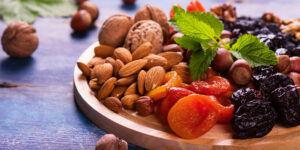
USDA FoodData Central (SR Legacy) gives canned carrot juice, per 100 g, 9,300 µg of beta-carotene, 956 µg of vitamin A as retinol activity equivalents, 40 kcal and 0.8 g of fibre. For comparison, its entry for Medjool dates gives 89 µg of beta-carotene per 100 g. A pitted Medjool weighs 24 g in the same database. Dates bring fibre instead, 6.7 g per 100 g in that entry. Vitamin A is not their strength.
How much juice counts
The NHS counts fruit juice, vegetable juice and smoothies as one 5 A Day portion only, however much you drink, and asks people to keep the combined total to 150ml a day. Its reason is teeth: crushing fruit and vegetables into juice releases their sugars, which can damage teeth, so juice is best had at mealtimes rather than as a snack between meals. The NHS gives the same mealtime advice for dried fruit such as dates.
A small glass with breakfast, alongside a couple of dates, fits both of those lines. This is general nutrition information, not medical advice.
More about this site is on the About Us page and the contact page. Other articles are listed on the blog.