
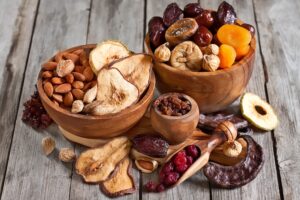
Some eating can happen while you are doing something else. A few dates from the jar while you iron a shirt, a biscuit while you check messages, breakfast eaten standing up with your keys in one hand. This article looks at that kind of getting-ready eating, and at what psychology labs found when people ate while distracted.
Distracted eating shows up later in the day
Researchers at the University of Birmingham reviewed 24 experimental studies on attention, memory and food intake. Eating while distracted produced a moderate increase in how much people ate at that sitting. The bigger effect came later: distraction increased intake at the next eating occasion to a greater extent. Making people remember what they had eaten reduced later intake, although that effect may depend on how prone they were to disinhibited eating.
The authors concluded that attentive eating is likely to influence food intake. That is a careful word, "likely", and it is worth keeping.
Two lunch studies with a snack test afterwards
At the University of Bristol, 44 people ate the same fixed lunch at a fixed rate. One group played solitaire on a computer while they ate; the other ate the same lunch with no distraction. Thirty minutes later everyone was offered biscuits in a taste test. The distracted group felt less full after lunch and ate about twice as many biscuits: 52.1 g on average, against 27.1 g. Their memory for the order of the nine lunch items was also less accurate.
A smaller Birmingham study had 16 young women eat a fixed lunch twice, once while watching television and once without it. They ate all of the lunch both times, and their appetite ratings during lunch did not differ. Later that afternoon they ate significantly more cookies after the television lunch, and they rated their memory of that lunch as less vivid.
Both studies point the same way. When attention is somewhere else, the brain seems to file the meal less clearly, and the snack that follows grows. Neither study involved dates, and neither was about mornings, so treat the getting-ready link as an application, not a finding.
Applying it to the rush out of the door
Getting ready is a distraction almost by design. You are watching the clock, finding a charger, answering a message. If you eat during that time, the lab results above suggest you may feel less full and eat more at the next snack. Two small changes follow from the research. Eat whatever you eat sitting down, with the phone face down. And give the food a moment of attention, since remembering a meal was the part that reduced later eating.
Where dates fit
Dates are easy to graze on from a jar, which is exactly the kind of eating the studies were about. The NHS lists dates, with raisins and apricots, as dried fruit that is high in sugar and can be bad for your teeth because it sticks to them. It says dried fruit is best enjoyed at mealtimes, as part of a dessert for example, rather than as a snack. So rather than picking at them while you get dressed, put a set number on a plate with a meal.
The numbers help you choose that set number. USDA FoodData Central lists one pitted Medjool date at 24 g, about 66 kcal and 16 g of sugar. One pitted Deglet Noor date is 7.1 g, about 20 kcal and 4.5 g of sugar. Three Medjool dates eaten without noticing are close to 200 kcal.
More on cravings and storage
If the morning meal is where you want to start, our piece on managing food cravings whilst getting wholesome looks at the Missouri breakfast trials. Keeping dates in the fridge rather than on the counter also takes them out of sight; the guide on storing food for a big family meal covers fridge temperature and leftovers.
More about this site is on the About Us page and the contact page.