
Most "raw food for younger skin" advice rests on one idea: cooking wrecks the good parts of vegetables, so eat them uncooked. The skin study behind this piece never asked whether the vegetables were raw. It asked how much of them women ate. Below is what that study found, what the food tables show about raw and boiled greens, and where a few dates sit beside them. This is general reading, not medical advice.
A study of 716 women in Japan
Nagata and colleagues, led from Gifu University Graduate School of Medicine, published the work in the British Journal of Nutrition in 2010 (PMID 20085665). It was a cross-sectional study of 716 Japanese women. The team measured the hydration, surface lipids and elasticity of each woman's skin with non-invasive instruments, and graded wrinkles at the corner of the eye (the crow's-foot area) by observation on the Daniell scale. Each woman's usual diet came from a validated food frequency questionnaire.
The results below are the ones reported after controlling for covariates, including age, smoking status, body mass index and lifetime sun exposure.
What it found
A higher intake of green and yellow vegetables went with a lower Daniell wrinkling score.
The fat results are less tidy. Higher intakes of total fat, saturated fat and monounsaturated fat were linked with greater skin elasticity, and saturated fat was linked with a lower wrinkling score once green and yellow vegetable intake was also taken into account. Nobody should read that as advice to eat more saturated fat. The NHS page on fats says current UK government guidelines advise cutting down on all fats and replacing saturated fat with some unsaturated fat.
The authors themselves close by saying that further studies with more accurate measurement methods are needed. A single snapshot of 716 women can show which habits travel together. It cannot show that a vegetable smoothed a wrinkle, and nothing in the abstract tests raw food against cooked food.
Raw or boiled greens on paper
The abstract does not list which vegetables made up the green and yellow group, so take spinach as one green leaf to see what boiling does. The USDA FoodData Central records (SR Legacy, 2019) give these figures per 100 g:
| Per 100 g | Spinach, raw | Spinach, boiled and drained |
|---|---|---|
| Vitamin C | 28.1 mg | 9.8 mg |
| Beta-carotene | 5,630 µg | 6,290 µg |
| Lutein + zeaxanthin | 12,200 µg | 11,300 µg |
So boiling cut the vitamin C figure to about a third, while beta-carotene came out slightly higher per 100 g in the boiled record and lutein slightly lower. Raw is not simply "better". It depends on the nutrient you are looking at.
On whether cooked food counts, the NHS 5 A Day page says: "Fruit and vegetables don't have to be fresh to count as a portion." It lists fruit and vegetables cooked in dishes such as soups, stews or pasta among those that count. Potatoes are the exception; the page says they do not count.
Where dates fit
Dates are a fruit, not a green or yellow vegetable, and their FDC records look very different from spinach. The Medjool record lists 89 µg of beta-carotene and 0 mg of vitamin C per 100 g. The Deglet Noor record lists 6 µg of beta-carotene and 0.4 mg of vitamin C. Next to spinach, those are small numbers.
They still count as fruit. The same NHS page says a 30g portion of dried fruit, such as currants, dates, sultanas and figs, counts as 1 of your 5 A Day, but should be eaten at mealtimes, not as a snack between meals, to reduce the impact on teeth. One way to put that on a plate: a spinach and chickpea curry for dinner, with a few dates eaten as part of the meal.
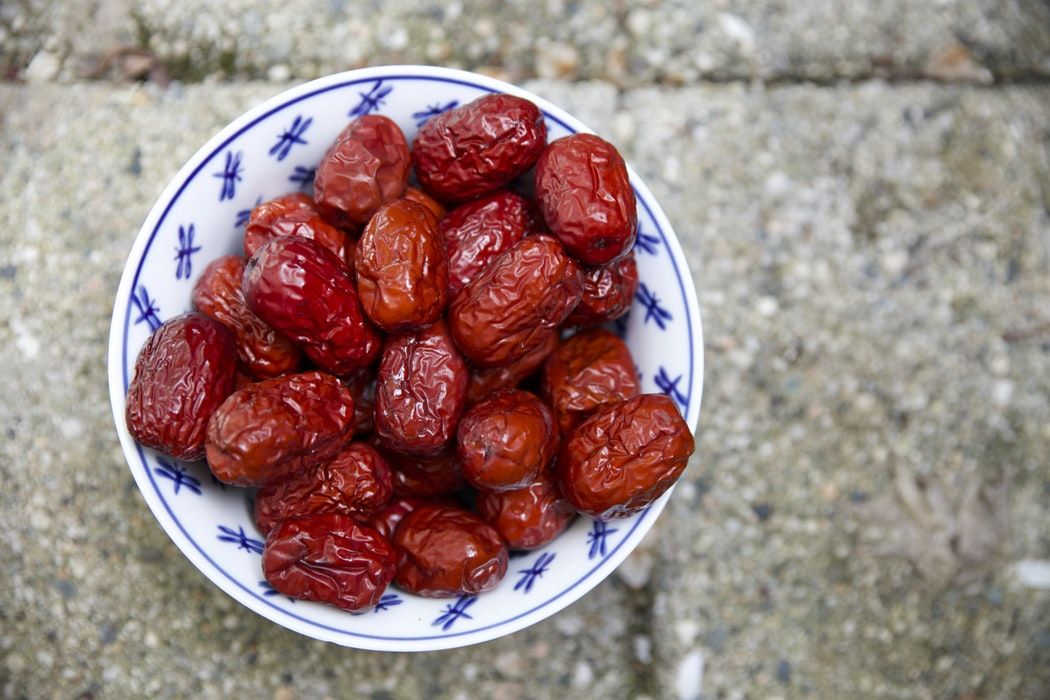
Readers in Selangor can also look at Pembekal Kurma Selangor. More about this site is on the About Us page and the contact page.
What this does and does not show
The Gifu study links eating more green and yellow vegetables with fewer crow's-foot wrinkles in Japanese women, after controlling for covariates including sun exposure, smoking, age and body mass index. It does not compare raw and cooked meals, and it does not prove cause. The food tables show that cooking lowers some nutrients in spinach and not others. If skin concerns are what brought you here, this site's earlier piece on acne and food covers what the studies there do and do not show.