
The title asks for a real magic pill for fat loss. The research below points somewhere duller: how many calories sit in each gram of the food on your plate. This article looks at what the evidence says about supplements, then at that one number, and at where a box of dates fits.
What a review of 315 supplement and therapy trials found
In 2021 Batsis and colleagues searched five research databases for randomised trials of weight-loss supplements and alternative therapies in adults (PubMed 34159755). They found 315 trials covering 14 products or therapies. Only 52 of them were judged low risk of bias and sufficient to support efficacy. Of those 52, 16 showed a significant difference in weight between groups, ranging from 0.3 kg to 4.93 kg.
The authors write that these products are "commercialized as a panacea" for weight gain because of minimal regulatory requirements to show they work, and they conclude that the products have a limited high-quality evidence base. Sixteen sound, positive trials out of 315 is the honest size of the magic.
Energy density, the number that does the work
Energy density means calories per gram of food. A 2018 review by Smethers and Rolls sets out the scale (PubMed 29156179). It runs from 0 calories per gram for water to 9 for fat, with fibre at 2, carbohydrate and protein at 4, and alcohol at 7. Water has the biggest influence, because it adds weight without adding calories.
The review sorts foods into four bands. Very low (0 to 0.6 calories per gram) covers most fruits and vegetables and broth-based soups. Low (0.6 to 1.5) covers cooked grains, beans and low-fat meats. Medium (1.5 to 4.0) takes in meat, cheese, bread, and snacks such as popcorn and pretzels. High (4.0 to 9.0) is crackers, chips, cookies, nuts, butter and oils, where the advice is to "carefully manage portions and frequency of eating".
The authors call lowering energy density "a key strategy" that works across different diet patterns, and say clinical trials show it is effective for weight loss and for keeping the weight off.
A year-long trial with fruit and vegetables
One trial of this idea ran for a full year (Ello-Martin and colleagues, PubMed 17556681). Ninety-seven women with obesity were split into two groups. One was counselled to cut fat. The other was told to cut fat and also eat more water-rich foods, fruit and vegetables in particular. Neither group was given a calorie target, and both could eat as much as they liked within their diet's rules.
Among the 71 who finished, the fruit-and-vegetable group lost 7.9 kg and the reduced-fat group 6.4 kg. The fruit-and-vegetable group ate a greater weight of food, ended with a lower energy density, and reported less hunger. That last point matters most for anyone who has quit a diet because they were hungry all the time.
Where dates sit on the scale
Dates are dried fruit. USDA FoodData Central gives Deglet Noor 20.5g of water per 100g, against 85.6g in a raw apple with skin. The same database lists Deglet Noor dates, a Tunisian and Algerian variety, at 282 kcal per 100g (record 171726) and Medjool at 277 kcal (record 168191). That works out to about 2.8 calories per gram, inside the review's medium band. A raw apple with skin is 52 kcal per 100g (record 171688), or about 0.5 per gram, in the very low band.
Put another way, and this is my own arithmetic on those records: 100 kcal of Deglet Noor is about 35g, or five pitted dates at the 7.1g per date that FoodData Central gives. The same 100 kcal of Medjool is one and a half pitted dates at 24g each. A hundred kcal of apple weighs about 190g.
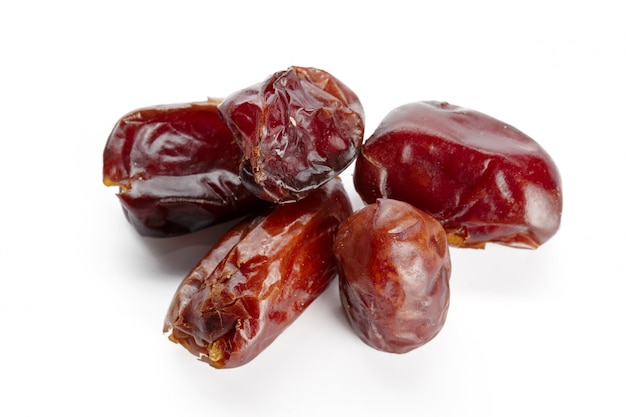
None of that makes dates a bad food. Deglet Noor carries 8.0g of fibre per 100g in the same record, and the review says fibre and protein have both been suggested to promote a feeling of fullness. It does mean a handful of dates is a portion to plan, not something to graze on.
Fitting dates into a lower-density day
The NHS counts 30g of dried fruit, dates included, as one of your 5 A Day, and says it should be eaten at mealtimes, not as a snack between meals, to reduce the impact on teeth. It puts that 30g level with about 80g of fresh fruit. On the FoodData Central figures, 30g of Deglet Noor is about 85 kcal and 80g of apple about 42 kcal, so the dried portion carries roughly twice the energy.
A few ways to use that. The first two come from the Smethers and Rolls review. Start a meal with a broth-based soup, a salad or whole fresh fruit; the review calls this "filling up first". Fill half the plate with fruit and vegetables. Then let a weighed 30g of dates finish the meal, where the sweetness replaces a dessert rather than adding to one. If you buy dates by the box, from a supplier such as Pembekal Kurma Selangor or anywhere else, weighing out 30g at a time keeps the box from turning into a snack jar.
If you are losing weight for a health reason, a GP or dietitian can set targets that fit you. For orders or questions about dates, the Kurma Mariami Malaysia about page covers who the shop supplies, and the contact page gives the WhatsApp number. More articles sit on the blog.