
Gout is a type of arthritis that causes sudden, severe joint pain, and it is caused by having too much uric acid in the blood (NHS). This guide starts at the supermarket, not the kitchen. So start there, with the trolley. The 2020 American College of Rheumatology guideline says diet changes likely make only small changes to uric acid levels, but that dietary factors may act as triggers for attacks (FitzGerald et al., 2020). What you buy is one part of the picture. The tips below take the shop aisle by aisle and stick to what the research and the NHS actually say.
This article is general information, not medical advice. If you have gout, follow the food list and treatment your own doctor gives you.
The drinks aisle
A 22-year study of 78,906 women with no history of gout recorded 778 new cases (Choi et al., 2010). Compared with less than one serving a month, two or more servings a day of sugar-sweetened soda carried a relative risk of 2.39, and two or more servings a day of orange juice carried 2.42. Diet soft drinks were not linked with gout. The authors added that these drinks probably make a modest contribution to gout across the whole population, because gout is not common in women.
The NHS gout page says not to have lots of sugary drinks and snacks, and to drink plenty of fluids to avoid getting dehydrated. Its 5 A Day page says to limit fruit juice, vegetable juice and smoothies to a combined total of 150ml a day. For alcohol, the NHS suggests some alcohol-free days each week and no more than 14 units a week.
Read labels for sugar, not just calories
The NHS advises checking the ingredients list: if sugar is near the top, the food is likely to be high in free sugars. Its list of other names for added sugars includes high-fructose corn syrup, corn syrup, fruit juice concentrate, honey, molasses and several words ending in "-ose": fructose, sucrose, glucose, dextrose and maltose. Compare two brands side by side before you decide.
High-fructose corn syrup is the one the gout guideline names. The ACR conditionally recommends limiting it, though it rates the evidence as very low and notes there were no data focused on patients who already have gout.
At the meat and fish counter
In a case-crossover study of 633 people with gout, a 2-day period in the highest fifth of purine intake carried 4.76 times the odds of a gout attack compared with a 2-day period in the lowest fifth (Zhang et al., 2012). Purine from animal sources carried the higher risk. The top fifth of animal purine had odds of 2.41, against 1.39 for plant purine.
The researchers' list of high-purine foods reaches well beyond the meat counter: meats, organ meats, meat extracts and gravies, seafood, beans, peas, lentils, oatmeal, spinach, asparagus, mushroom, yeast, beer and other alcoholic drinks. Even with legumes on that list, the same authors wrote that plant foods, especially nuts and legumes, should be the preferred protein sources for people with gout. A smaller pack of meat or seafood, and a bag of lentils or beans beside it, follows that advice.
Swap one thing at a time
Change one thing at a time. Pick one recurring item, such as the sugary drink or the afternoon biscuit, and swap only that for two weeks. Water in place of a sweet drink fits both the NHS fluids advice and the soda findings above.
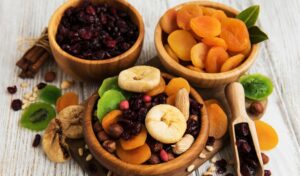
Dates are not a free swap for the biscuit tin. They are a fructose-rich fruit: USDA FoodData Central lists 32.0 g of fructose per 100 g of Medjool dates and 19.6 g per 100 g of Deglet Noor dates. None of the studies above tested dates themselves, so they give no evidence either way on whether dates trigger gout attacks or prevent them. The NHS 5 A Day page counts a 30 g portion of dried fruit, dates included, as one of your 5 A Day, and says it should be eaten at mealtimes, not as a snack between meals, to reduce the impact on teeth (NHS). Buy them for the end of a meal and weigh one 30 g portion so you know the size.
Cook in batches you'll actually eat
Freeze portions in amounts that match one meal, not a whole pot. A single-serve container of soup or curry gets eaten, and it keeps the meal a normal size. That matters here: the NHS lists eating a very large meal, along with drinking too much alcohol, among the things that can trigger a gout attack. Label each container with the date you cooked it.
On gout and your doctor's plan
The NHS says your doctor may give you a list of foods to include or limit, and that uric acid-lowering medicine should be taken regularly, even when you no longer have symptoms. Vitamin C is one place where sources differ. The NHS says to ask a GP about vitamin C supplements, while the ACR guideline conditionally recommends against adding them, after two small trials of 29 and 40 patients showed clinically insignificant changes in uric acid. Grocery habits support your doctor's plan. They don't replace it.
Better eating starts at the till: check the drinks, read the label, go lighter at the meat counter and keep dates for mealtimes.
For dates to keep for mealtimes, see what we offer at Kurma Mariami. Our about page has more on Kurma Mariami Malaysia, and the contact page has our WhatsApp number.
References
- NHS. Gout. https://www.nhs.uk/conditions/gout/
- NHS. 5 A Day: what counts? https://www.nhs.uk/live-well/eat-well/5-a-day/5-a-day-what-counts/
- NHS. Sugar: the facts. https://www.nhs.uk/live-well/eat-well/food-types/how-does-sugar-in-our-diet-affect-our-health/
- FitzGerald JD, et al. 2020 American College of Rheumatology Guideline for the Management of Gout. Arthritis Care Res (Hoboken). 2020;72(6):744-760. PMID 32391934
- Zhang Y, et al. Purine-rich foods intake and recurrent gout attacks. Ann Rheum Dis. 2012;71(9):1448-53. PMID 22648933
- Choi HK, Willett W, Curhan G. Fructose-rich beverages and risk of gout in women. JAMA. 2010;304(20):2270-8. PMID 21068145
- USDA FoodData Central (SR Legacy). Dates, medjool, FDC 168191. https://fdc.nal.usda.gov/food-details/168191/nutrients
- USDA FoodData Central (SR Legacy). Dates, deglet noor, FDC 171726. https://fdc.nal.usda.gov/food-details/171726/nutrients