
This post's title promises weight loss that is simple, through a raw diet. Before changing a single meal, there is a smaller step that one research team called "a simple, straightforward message": change what you drink. The trial below tested it for six months. Its results are modest, and the details are worth knowing before you count on it.
The CHOICE trial: six months of swapped drinks
Researchers at the University of North Carolina at Chapel Hill ran the Choose Healthy Options Consciously Everyday trial, CHOICE for short (Tate et al., 2012). It enrolled 318 adults with overweight or obesity. 84% were women, the average age was 42, and 54% were Black. Two groups replaced drinks with calories, at least 200 kcal a day of them, with drinks without calories: diet drinks in one group, plain water in the other. The third group, the attention control, made diet changes of their own choosing.
After six months the average weight loss was 2.5% in the diet-drink group, 2.03% in the other swap group and 1.76% in the attention-control group. The abstract, as corrected in 2013, says there were no significant differences between groups in these averages. The groups did differ on reaching a 5% loss. The diet-drink group had better odds than the control group (odds ratio 2.29), and the two swap groups taken together were about twice as likely as the control group to get there (2.07). The authors sum it up as "average weight losses of 2% to 2.5%".
The result in plain numbers
For a person weighing 80 kg, 2% is 1.6 kg and 2.5% is 2 kg, spread over six months. The NHS weight-loss tips suggest aiming "to lose 1 to 2lbs, or 0.5 to 1kg, a week" (NHS, Tips to help you lose weight), so the CHOICE averages sit well below that pace. The control group, who picked their own changes, was not far behind on average. What the trial does show is narrower. One swap, held for six months, did about as well as self-chosen changes, and the swap groups together had about twice the odds of reaching 5%.
What the NHS says about drinks
The same NHS tips page lists "swap sugary drinks for water – if you do not like the taste, add slices of lemon or lime for flavour" among the things to do. The NHS page on drinks goes further (NHS, Water, drinks and hydration). It suggests 6 to 8 cups or glasses of fluid a day as a guide, and says to "swap sugary drinks for diet, sugar-free or no added sugar drinks". It also says "do not have drinks that are high in sugar too often – they're higher in calories and the sugar can damage your teeth".
The NHS sugar page gives the scale (NHS, Sugar: the facts). Adults should have no more than 30g of free sugars a day, and "a can of cola can have as much as 9 cubes of sugar – more than the recommended daily limit for adults."
Fresh juice is raw, and it still counts as a drink
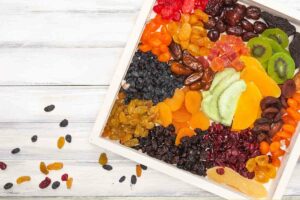
A glass of freshly pressed juice involves no cooking, so it fits a raw menu. The NHS still counts the sugar in it as free sugar: sugar in fruit "is not considered free sugars unless the fruit is juiced or puréed." The drinks page says to "limit fruit juice and smoothies to a maximum of one small glass (150ml) a day and drink with a meal". Whole fruit is a different case. The NHS 5 A Day page counts "a 30g portion of dried fruit, such as currants, dates, sultanas and figs" as one portion, to be eaten "at mealtimes, not as a snack between meals" (NHS, 5 A Day: what counts?).
| Food (USDA FoodData Central) | kcal per 100 g | Total sugars per 100 g |
|---|---|---|
| Cola, regular, carbonated | 42 | 9.94 g |
| Orange juice, raw | 45 | 8.4 g |
| Apple, raw, with skin | 52 | 10.4 g |
| Dates, Medjool | 277 | 66.5 g |
By these figures, 200 kcal a day of drinks, the minimum the CHOICE swap covered, is about 476 g of regular cola or about 444 g of fresh orange juice. A 30 g portion of Medjool dates is about 83 kcal. Gram for gram the dates are far richer than any drink in the table, so the portion size matters more than the label "raw". Sources: FoodData Central entries 174852, 169098, 171688 and 168191.
The post Raw Diet - Easy Weight Loss looks at what a salad served at the start of a meal does to the rest of it, and Juice For Fasting - Best Foods To Eat Subsequent A Juice Fast covers the food group a juice fast leaves out. If you're worried about your weight, the NHS advice is to ask your GP or a dietitian (NHS, 8 tips for healthy eating).
More about this site is on the About Us page and the contact page.