
Part of a food bill can go on things that are not food: the brand on the box, a second pack of something that does not count twice, a bottle of something you could have poured from the tap, a leftover that ends up in the bin. These ten suggestions go after those leaks one at a time. The first rests on a US laboratory study. The other nine use public guidance from the NHS and the UK Food Standards Agency (FSA), plus one USDA food record for the dates.
At the shelf
1. Try the shop's own brand first
Between 2010 and 2014 the Nutrient Data Laboratory of the US Department of Agriculture obtained 1,706 samples of 61 packaged foods from up to 12 locations across the United States, in both store-brand and national-brand versions, and chemically analysed them. The paper's authors, Ahuja and colleagues, note that store brands make up about one in four foods sold in US supermarkets and "provide value to consumers due to their low cost". Their result: across all the foods sampled, sodium, potassium, fibre, total and saturated fat and total sugar showed no statistically significant difference between the two kinds of brand (PubMed 28169210). There were differences in both directions for a few single products, so it still pays to look at the pack.
2. Let the label decide, not the logo
That look takes seconds. The NHS page on food labels says all nutrition information is given per 100 g or per 100 ml, and calls this very useful when you want to compare products at a glance. Its guide marks more than 22.5 g of total sugars per 100 g as high and 5 g or less as low, with similar lines for fat, saturated fat and salt. If the cheaper pack sits in the same band as the dearer one, the difference in price is paying for something the label does not measure.
3. Don't walk past the freezer cabinet
According to the NHS 5 A Day page, 80 g of fresh, canned or frozen fruit and vegetables counts as one portion. A bag of frozen peas or mixed vegetables counts the same towards 5 A Day as the fresh ones, so you can pick on price and on how soon you will use them.
4. Pick tins in water or juice
The same page asks you to choose tinned fruit and vegetables in natural juice or water, with no added sugar or salt. A tin that passes that test counts as a portion like any other, so a cheaper tin is not a lesser choice.
What not to buy twice
5. One portion of beans is enough for the count
Beans and pulses, the NHS says, count once towards your 5 A Day no matter how many you eat. Buy them because you like them in a dish. A second tin bought to tick another box adds nothing to the count.
6. Keep juice to one small glass
The NHS limits fruit juice, vegetable juice and smoothies to a combined total of 150 ml a day. Juice beyond that adds no further portion, so there is no reason to buy more than the household drinks at that rate.
7. Pour water
The NHS water and drinks page puts it in one line: water is a healthy and cheap choice to keep you hydrated. Each bottled drink swapped for a glass of water is one less item on the receipt.
After you get home
8. Cook once and freeze in portions
The FSA's guide "How to chill, freeze and defrost food safely" calls the freezer a pause button: food in a freezer won't go bad, and most bacteria cannot grow in it. It suggests freezing in individual portions so you defrost only what you need, and labelling what you freeze so you don't end up with "Unidentified Frozen Objects". Fruit, vegetables and baked goods, it says, are best within three to four months, and meat within two to three. The FSA's tips on properly storing food for a crowded festive kitchen are on this site too.
9. Give leftovers a deadline
The same guide says to eat leftovers within 48 hours or freeze them if that won't be possible, and to use defrosted food within 24 hours. A dish eaten on day two, or frozen on day one, is a meal already paid for. A dish found at the back of the fridge on day five is not.
10. Buy dates by the portion you will eat
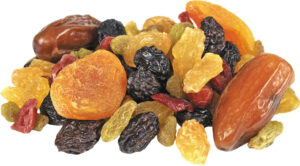
On the NHS list, a 30 g portion of dried fruit such as currants, dates, sultanas and figs counts as one of your 5 A Day, eaten at mealtimes rather than as a snack between meals to reduce the impact on teeth. The USDA FoodData Central record for Medjool dates (FDC 168191) gives one pitted date as 24 g, so a portion works out at about one and a quarter Medjool dates. Mariami, the date in this site's name, is an Iranian variety, dark, semi-dry and chewy. Mazafati needs refrigeration, so its box needs fridge space before it goes in the trolley. Whatever the variety, a pack sized to what the household eats at meals is a pack that doesn't end up in the bin. For the rest of the plate, the daily healthy eating plan measures portions by hand and spoon.
More about this site is on the About Us page and the contact page.