
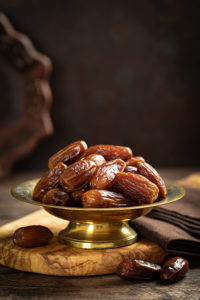
Picking healthy food for the people you cook for is a question of nutrition and a question of money at the same time. The British Nutrition Foundation (BNF) has a page called "Eating healthily on a budget" that handles both together. Below are several of its tips, applied to a family shop, with a note on where a box of dates fits and a carrot and date side dish to finish.
Plan the week before you shop
The BNF's first tip is to plan meals and write a shopping list. It says planning "can make it less likely for us to be tempted into buying unnecessary items, help us cut down on waste and save money". It also suggests checking the foods you already have at home and using them in your meal planning. In practice that means opening the fridge and the cupboard before deciding the week's meals, not after.
Compare prices by weight, not by pack
Offers are hard to judge when packs come in different sizes. The BNF notes that the cost per 100g or 100ml is sometimes printed in small print on the shelf label, and suggests using your phone's calculator to check. It also warns that the shelf label "may not be updated to reflect special offers or promotions". The same sum works for any pack of dates: divide the price by the weight in grams, then multiply by 100, and two packs of different sizes can be compared fairly.
Frozen and canned produce still count
Fresh is not the only sensible choice. According to the BNF, canned and frozen fruit and vegetables "are often cheaper than fresh", and frozen vegetables "still count towards your 5 A DAY". A frozen bag also lets you take out the exact amount you want, which helps with waste. For canned fruit and vegetables, the page says to watch out for added sugar (syrup) or salt and to pick those in fruit juice or water instead.
Proteins that keep in the cupboard
The BNF lists canned fish, beans, lentils (canned or dried) and eggs as relatively low-cost proteins that can be stored. To make meat go further, it suggests adding chickpeas to a chicken curry, lentils to a meat-based pasta sauce or tofu to a stir fry. It says we should all aim to eat two portions of fish per week, one of which should be oily, and that canned fish like sardines and tuna is normally cheaper than buying fresh fish.
Cooking for fussy eaters
Feeding loved ones also means feeding their tastes. The page suggests using at least two different vegetables with dinner. For fussy eaters, it mentions grating carrots or adding some frozen vegetables to sauces. Overripe fruit can be blended with milk, yogurt or fruit juice into a smoothie, or added to stews such as tagine for a naturally sweet flavour.
Where dates fit in the basket
The NHS 5 A Day page names dates directly as a dried fruit: "a 30g portion of dried fruit, such as currants, dates, sultanas and figs, counts as 1 of your 5 A Day". The same page says dried fruit should be eaten at mealtimes, not as a between-meal snack, to reduce the risk of tooth decay. So dates belong at a mealtime rather than in a snack tin.
How many dates make 30g depends on the variety. USDA FoodData Central lists one pitted Medjool date at 24g, so a portion is a little over one Medjool date. It lists one pitted Deglet Noor date at 7.1g, which puts a 30g portion at about four of them.
The BNF says best-before dates appear on a wide range of frozen, dried, tinned and other foods, and that they "are more about food quality than food safety". It adds: "Always store the foods as described on the food packaging." That is the instruction to follow for any pack of dates too.
A carrot and date side dish
Carrots are one of the vegetables the BNF suggests for fussy eaters, and this side dish pairs them with dates so the dried fruit is eaten as part of a meal.
Ingredients: peeled carrots, olive oil, salt, black pepper, garam masala, cinnamon powder, chilli powder, ginger juice and chopped dates.
For the ginger juice, grate fresh ginger root and press the pulp over a metal colander to collect the juice.
Preheat the oven to 210°C. Put the carrots in a bowl with the olive oil, salt, pepper, spices and ginger juice, and stir until every carrot is coated. Spread them on an oven tray, cook in the middle of the oven for 20 to 22 minutes until soft, then mix in the dates and serve.
Less waste at home
The BNF says UK households throw away 6.6 million tonnes of food a year. Its suggestions for cutting that include measuring pasta and rice before cooking rather than guessing portions, trying not to cook more than you need, and setting the fridge between 0 and 5 ºC to avoid food going off unnecessarily. Leftover vegetables can go into soup, pasta, couscous or rice.
For more everyday meal ideas, this site also has articles on meals that carry calcium and on healthy eating and the balanced diet.
More about this site is on the About Us page and the contact page.