
The same plate of food does not smell the same at eleven in the morning and at half past one. Before lunch it pulls at you. After lunch the identical smell is just there. Researchers call this shift alliesthesia, and lab studies have measured it. None of the four studies below tested a weight-loss diet, so they are not a fat loss plan. What they show is how hunger, fullness and stress change the way food smells and tastes.
A full stomach sharpens the nose but dulls the pull
A study whose lead author was at Ludwig-Maximilians-University Munich tested 24 healthy women with normal smell, once hungry and once satiated (Rhinology 2009, PubMed 19593973). They used the threshold test from the Sniffin' Sticks kit with two odours: isoamyl acetate, a food-related smell, and n-butanol, a non-food smell.
The non-food threshold did not change. For the food odour, the women detected it at a lower concentration when they were satiated than when they were hungry, and they rated it less pleasant. The authors point out that this runs against the idea that food intake is held in check by smelling food less. In their setting, people smelled the food odour better after eating and simply liked it less.
Fatty food smells lose the most appeal
A study in Appetite whose lead author was at the Centre des Sciences du Goût et de l'Alimentation in Dijon (2011, PubMed 21801771) compared food and non-food odours in hungry and satiated states. Food odours, fatty and non-fat, were judged less pleasant and less appetent after eating than when hungry. Non-food odours showed no such difference.
The drop in appetence, the measure of wanting to eat, was greater for fatty food odours than for non-fat ones. The drop in pleasantness was about the same for both. In other words, after eating, the smell of a fatty food lost more of its pull than the smell of a non-fat food did.
Stress and the moment a flavour stops appealing
A 2024 study from Southwest University in Chongqing (Physiology & Behavior, PubMed 38316171) split 76 participants into high-stress and low-stress groups by their Perceived Stress Scale scores. Each ate either banana milk or corn soup until comfortably satiated, and rated how much they liked and wanted the flavour and the odour of the eaten and the uneaten food, before and after. Comparing the two is how the study measured sensory-specific satiety.
The high-stress group showed a blunted sensory-specific satiety to the whole flavour of the food. For the odour alone, sniffed or sensed from inside the mouth, the two groups did not differ. Across everyone, people who scored higher on a questionnaire about awareness of their own body signals showed stronger sensory-specific satiety (r = 0.29).
Bite size, not aroma, separated the groups
A pilot study whose lead author was at the Top Institute Food and Nutrition in Wageningen (British Journal of Nutrition 2011, PubMed 21385504) matched 27 normal-weight adults with 27 overweight or obese adults by sex, age and dietary restraint. Both groups ate a spiced rice meal and an apple pie yoghurt on separate days, and on a third day the researchers measured how much aroma reached the nose from inside the mouth.
The only significant difference was bite size for the spiced rice: 10.3 g in the overweight and obese group against 8.7 g in the normal-weight group. Aroma release did not differ, and the eating behaviours were not correlated with BMI or with aroma release. The authors concluded that eating behaviour "might be a characteristic of an individual but not by definition a characteristic for a group of people based on their weight".
Where dates fit into a day like this
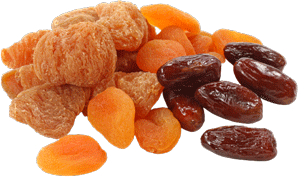
The NHS counts "a 30g portion of dried fruit, such as currants, dates, sultanas and figs" as one of your 5 A Day, and says it "should be eaten at mealtimes, not as a snack between meals, to reduce the impact on teeth". That places dates with meals rather than in the gap between them.
Mariami dates come from Iran and are dark, semi-dry and chewy. USDA FoodData Central has no Mariami record. Its Deglet Noor record lists 282 kcal per 100 g, which is about 85 kcal for a 30 g portion.
For more on choosing food for a household, see tips to pick out healthy foods for the loved ones.
More about this site is on the About Us page and the contact page.